If you are reading this page, then congratulations, you have taken your first steps into enjoying the brilliant game of Dungeons and Dragons!
Dungeons and Dragons has blown up in the past few years because of shows like Critical Role and Stranger Things, which is great for getting more people into the game! The only downside is that the game can look really intimidating for newcomers, because there are a ton of books and, if we are being honest, a lot of people who like to gatekeep!
I’ve played D&D since I was a teenager, back when the rules were unbelievably difficult, and the game wasn’t quite as easy to pick up, so you have literally come into the D&D world at the perfect time!
On this page, I will give you a low-down of what Dungeons and Dragons is, how to play it and a little bit of a background to get you started. Don’t worry, it’s not as difficult or intimidating as it sounds!
There are two things that I want to say, just before we get started. Firstly, I want this page to be the most helpful as it can, so if i’ve not explained something 100% for you or you have further questions, please reach out to me or comment on the page so that I can answer it for you and others who are looking to get into Dungeons and Dragons, and second is that I have eBay links on the page that i may earn a small commission from if you decide to click on them (I just like to be transparent!)
Here is a quicklist of what is included on this page
- What is Dungeons and Dragons
- Can you win Dungeons and Dragons?
- Do I need to act or put on a voice?
- What do I need to play?
- So how does the game work?
- How do the fights work?
- Dungeons and Dragons Terminology
So, what is Dungeons and Dragons?
Dungeons and Dragons (Also known as D&D) is a tabletop role-playing game (Also known as TTRPG). In essence, it’s a board game that you play with friends, but isn’t limited by what is on a traditional board! Basically, it’s a shared storytelling game that you can play the game however you like, without boundaries.
There are two different types of players in the game. The Dungeon Master and the Player Characters.
The Dungeon Master
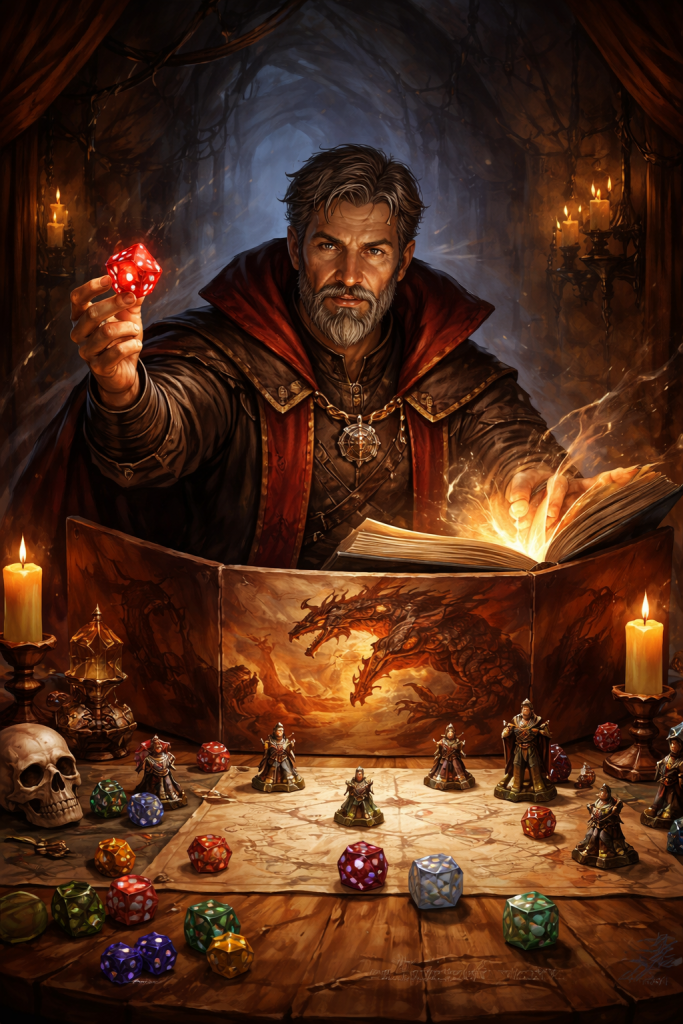
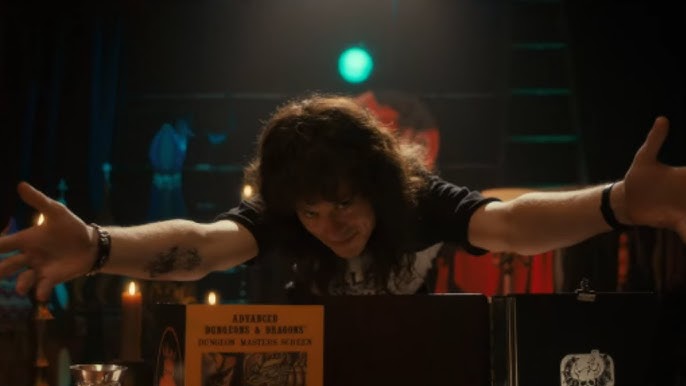
The Dungeon Master is the person who tells the story to you, describes your surroundings and is basically your guide in the world. In simple terms, you can see them as the host of the game. They will guide you through the rules, fights and lay out what your characters can see in the game.
Player Characters
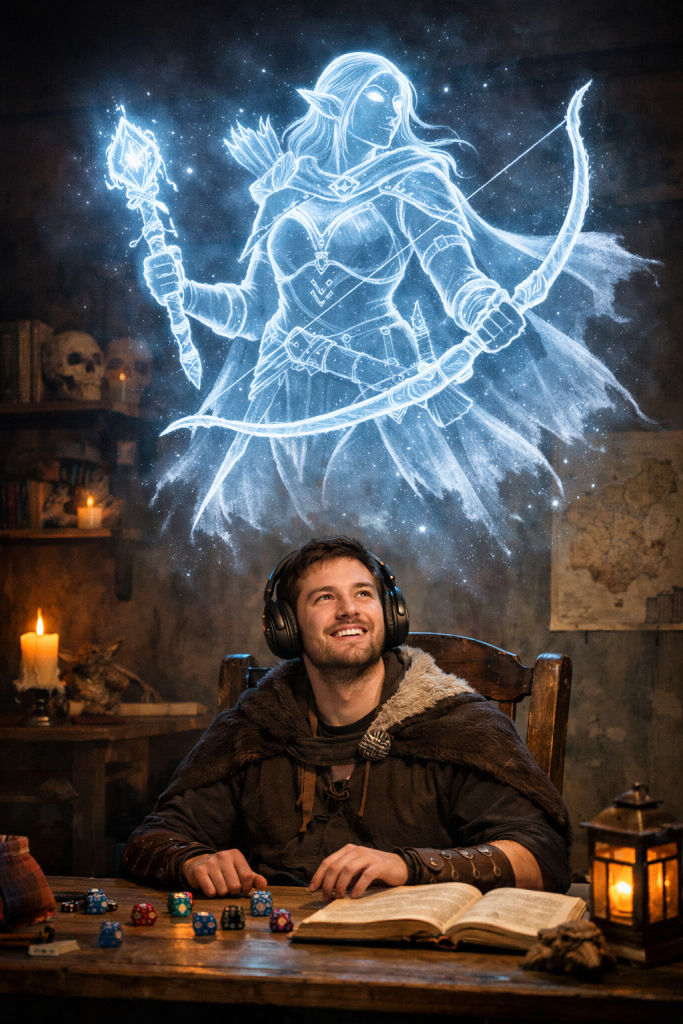
Everyone else in the game takes on the role of their very own character that they create, each with their own set of strengths and weaknesses. You will control every aspect of this character, from fighting, talking to people and buying things from the stores! Some beginner games come with pre-made character sheets, so that you don’t need to faff about creating your own character, but once you play, you will see that creating your very own character really takes the game to a new level!
Can you win at Dungeons and Dragons?
This is one of those questions that people fight about, but the answer is really both yes and no! If you are playing a short game where the goal is to beat a bad guy, and you don’t intend to play as those characters ever again… Then yes, you can win at Dungeons and Dragons.
The reason that so many people say that you can’t win is that the idea of Dungeons and Dragons is that you can then use your character in all other games too, essentially making the game unlimited, so there isn’t an end, so to speak. You can just keep playing new stories with the same character!
Do I need to act or put on a voice?
The honest answer to this one is… If you want to, but you don’t have to! The brilliant thing about Dungeons and Dragons is that you can play it exactly how you want to. If you want to go all out and cosplay as your character, put on their voice and act how they act while you are playing, then go for it! If you don’t want to put a voice on or even do any role-playing, that’s fine too!
Everyone has their own way of playing, and it doesn’t take away from the game if you do it one way or the other, it just boils down to how you are comfortable playing. For context, when we play D&D with my friends, we do a little bit of voices (when we want to) because it’s fun, but we wear normal clothes, don’t stay in character all the time and just have an absolute blast playing!
What do I need to play?
The great thing about D&D is that it’s pretty cheap to get started. There are only a few things that you need to get started. Once you have these sorted, your imagination can do the rest.
The Dice
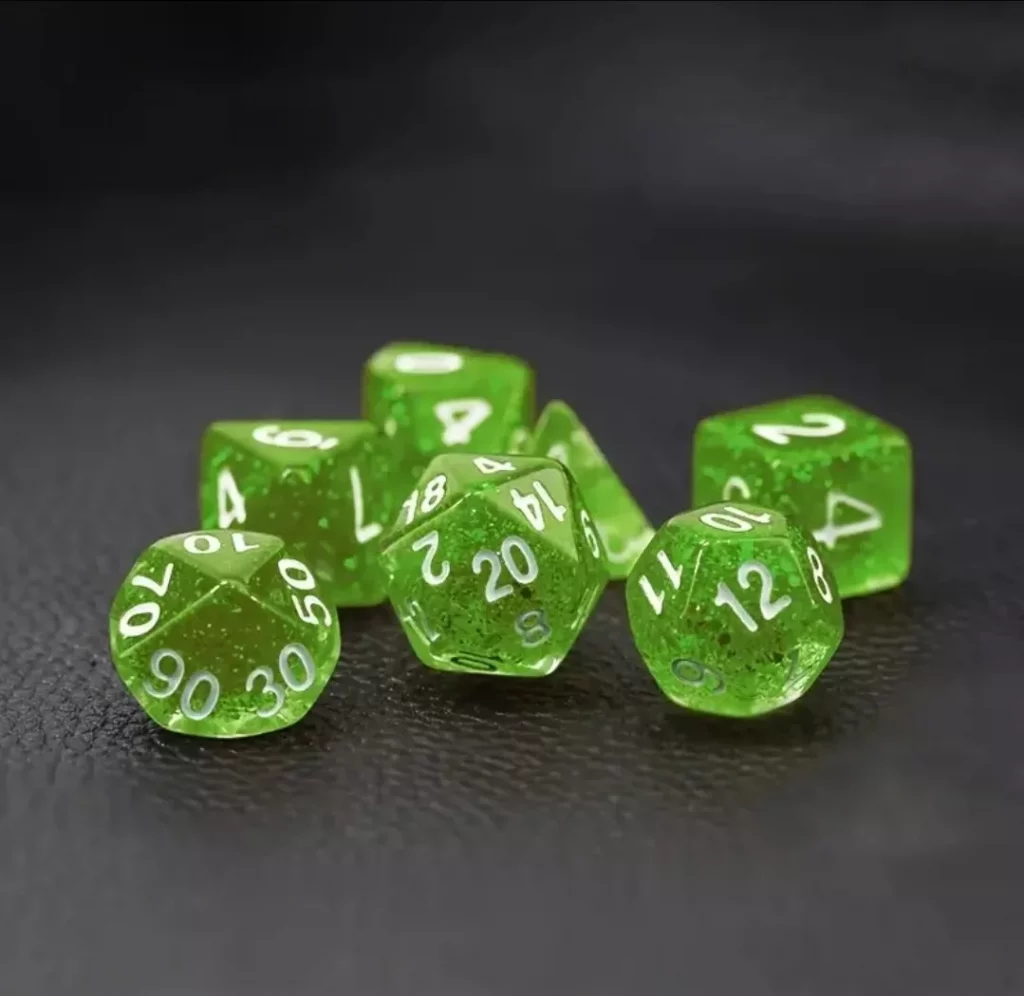
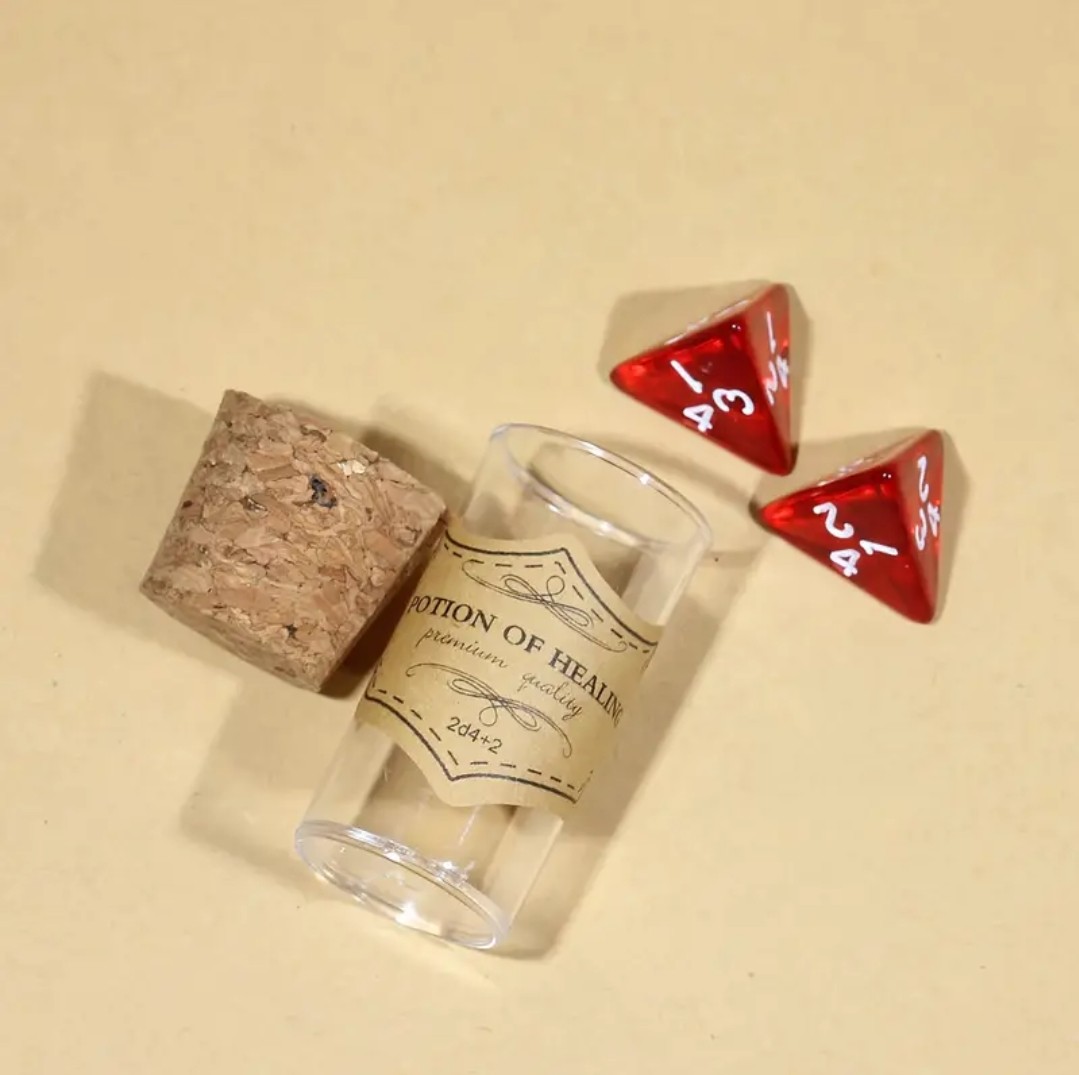
When you are playing Dungeons and Dragons, it’s important that you have the correct dice before you start (these aren’t your usual board game dice). The dice sets that I have up on eBay (Here is one of the colours) have all 7 dice that you will need to play the game:
- 20-sided dice (D20)
- 12-sided dice (D12)
- 2x 10-sided dice (D10)
- 8-sided dice (D8)
- 6-sided dice (D6)
- 4-sided dice (D4)
The dice that you will use the most will be the 20-sided dice (Also known as the D20. D for dice, and 20 for the number of sides it has. This die is used throughout the game to determine if you succeed in your actions.
You will also notice that there are two of the 10-sided dice (D10) in the set, too. This is because sometimes you need to work out a number out of 100 (You roll the first and second numbers). So if you were to roll a 9 and a 6, that would be a 96 in terms of the game (although you rarely roll out of 100, but it’s there in case you need to).
If you don’t want to commit to buying a set of dice, there are free dice apps available (but the game feels so much better with real dice!)
Character Sheets
A character sheet is basically a piece of paper that you write down your stats (like how strong you are, how agile), what equipment you have (swords, shields, potions) and things like your hit points.
Here is a direct link to the official character sheet that you can print out for free!
The Rules
Now for the reading (sorry). The rules will look like quite a lot to get your head around, and that is the thing that puts so many people off, but please don’t let that be you. The books are pretty big, but you won’t use the majority of them (especially not as beginners). It’s mostly there as a reference guide, if you’re unsure of something that comes up in the game.
There are a couple of ways that you can get the rules:
Starter Sets
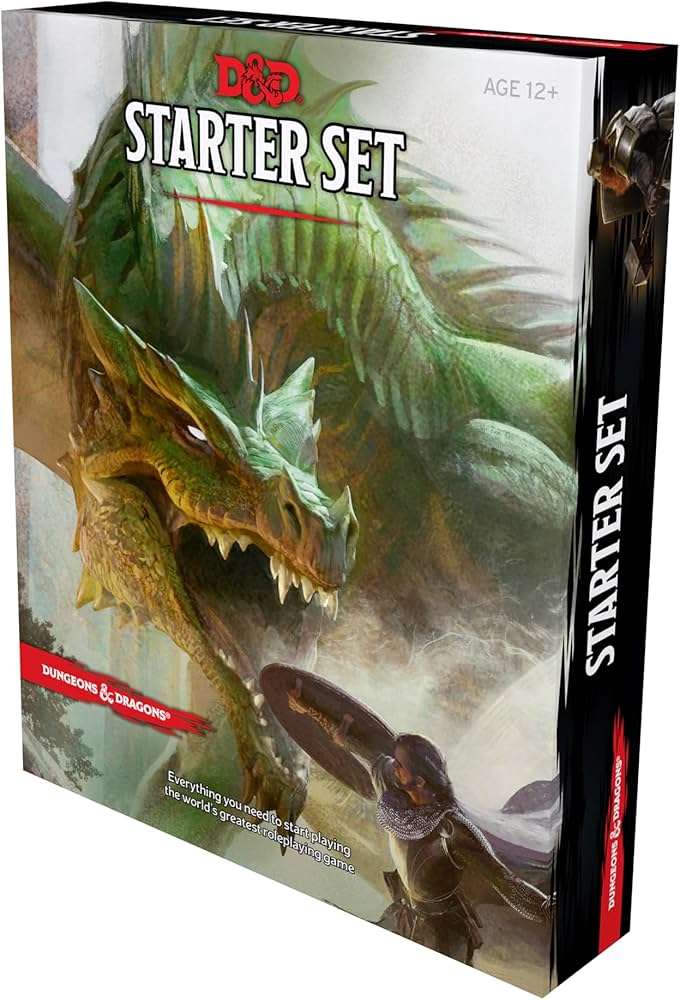
If this is your very first game, then it might be best to get yourself one of the starter sets. These sets give you the essential rules so that you can get started a lot quicker, and the bonus is that you won’t get overwhelmed, like you might if you buy the ‘Core’ books first. You can pick up the starter sets cheap on eBay here.
What I would advise is that you watch a couple of episodes of ‘Critical Role’ to get you into the swing of things, too. Critical Role is a show where a group of excellent voice actors sit around and play Dungeons and Dragons… It’s hilarious, entertaining, but most of all, it really shows you how to play the game! It won’t show you all the rules, but it gives you enough of an idea that you will be much more confident when you play.
You can check Critical Role out on their YouTube Channel here.
Once you watch a couple of episodes of Critical Role, you can either buy yourself a beginner’s episode or buy the ‘Core’ books
The Core Books
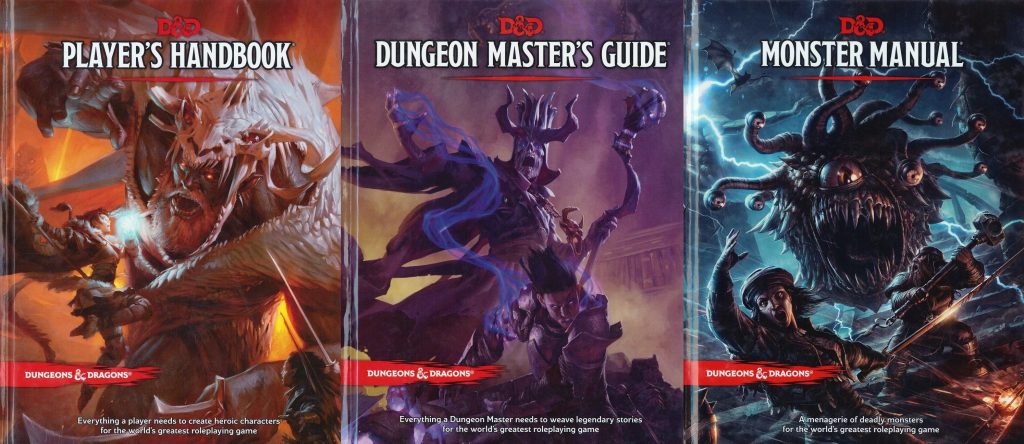
There are a lot of D&D books that you can get to help your game, but really, there are 3 main books that you should get:
- The Player’s Handbook – This is a reference guide for the player characters (how to create a player, how much damage specific weapons do, etc) – You can pick it up cheap on eBay
- The Dungeon Master’s Guide – This is a reference guide for the Dungeon Master, that goes over things like how fighting works, creating stories, etc – You can pick it up on eBay here
- The Monster Manual – Finally, this one is basically pre-made monsters that the Dungeon Master can use in fights. It’s really easy to use as each of the monsters has a ‘stat block’, which is basically everything you need to know about it, all in one place. You can also pick this up for cheap on eBay too.
The main thing to triple-check is that the books that you buy either say 5E, 5th Edition or 5.5E on them (all the listings specify this and the covers are above), as these are the new books with the simpler rules.
So how does it work?
It’s really easy once you get to know what to do, but i’ll break it down in it’s simples form in 5 steps:
- The Dungeon Master describes a situation
- The Players say what they want to do
- The Dungeon Master may ask for a roll of the dice
- The roll of that dice determines if you succeed or fail
- The Dungeon Master then describes what happens next
Yes, it really is as simple as that. The above 5 points then just repeats itself over and over again!
How do the fights work?
Fights in Dungeons and Dragons are some of the most memorable parts of the game. There is really nothing better than landing the killing blow on some terrible monster and being hailed as champions
Although fights (also called combat) sound a bit complicated, it’s actually really simple when you break it down to the basics.
Starting a fight
When a fight is initiated, all players and monsters roll an initiative roll. An initiative roll is a roll of your 20-sided dice (adding any bonus points your character might have), which determines what order people take their turns. The higher the roll, the more likely you are to have your turn first.
What do you do when it’s your turn?
During your turn, you have 3 things that you can do each time:
- Movement – You can move your character up to a specific distance that is determined by your ‘Speed’ on your character sheet.
- Action – This is the main thing that you want to do each turn. That might be using your weapon to attack, using a spell, or using an item.
- Bonus Action – Some characters have a smaller action each turn, on top of their main action. This is typically a skill or spell that will usually have ‘BA’ or ‘Bonus Action’ written next to it.
Once you have done all, or a mix of this list, your turn is ended, and you move onto the next person in the initiative list, so that they can take their turn. Once everyone has had their turn, you start back at the top of the initiative order and repeat until the battle is over.
The battle is over when the enemy is defeated, they surrender, or they retreat beyond the ability to reach them.
Dungeons and Dragons Terminology
Sometimes, the most frustrating thing for players is when they hear common terms or nicknames for things in the game, but don’t know what they actually mean. In this section, I’ll note down all of the terminology that you might come across in the game and what it means, instead of the jargon (this list will grow as I remember more!).
- D&D – Short for Dungeons and Dragons
- D20 – Short for 20-sided Dice (This also applies to any dice you use. It would simply be a D, followed by the number of sides on the dice, like D4, D8, D10, D12)
- DM – This is short for Dungeon Master
- GM – This is short for Game Master. In some role-playing games, the Dungeon Master is called a GM. It means the same thing, though
- PC – Short for Player Characters
- NPC – This is short for Non-Player Character. Essentially someone or something in the game that isn’t one of the players (It could be a barkeep or a blacksmith that you talk to in the game)
- TTRPG – Short for TableTop RolePlaying Game
- Crit – Short for Critical Hit. This is when you roll a 20 on your 20-sided dice
- Nat 1 – this is when you roll a 1 on your 20-sided dice.
- Fumble – A fumble can happen when you roll a 1 on your 20-sided dice. It’s optional, but the Dungeon Master could make something negative happen to you, for fun
- Rule of Cool – This term basically means that if something is awesome, the DM may allow it, even if it isn’t strictly allowed in the rules
- Session – A session is simply one sitting of playing the game. So if you play for 5 hours on one day, then again on another day, you have played two sessions of D&D.
- Campaign – An ongoing story, made up of multiple adventures.
- One-shot – This is the terminology for a short campaign that usually just takes one session to play.
- Alignment – This is basically your character’s moral compass.
- Modifier – A modifier (or mod) is a bonus or penalty that you apply to whatever you are doing.
- Initiative – This is a roll that everyone does at the start of battle. This determines who goes first. The person with the highest number starts the fight.
- AC – Short for Armor Class. Essentially, the number that you need to roll to be able to hit something.
- HP – Short for Hit Points. When your Hit Points reach 0, you fall unconscious and could die!
- Attack Roll – You roll a D20, to see if you hit your target.
- Damage Roll – You roll a specific die (It depends on what weapon you are using) and you deal that amount of damage to the enemy.
- Death Saving Throw – Once you are unconscious, you roll a D20 to see if you remain alive. These are Death Saving Throws.
- Saving Throw – You roll a D20 to see if you resist a spell, trap or harmful effect.
- Advantage – You roll your D20 twice and take the higher number
- Disadvantage – You roll your D20 twice and take the lower number
- RAW – Raw refers to the rules as they are written. Some DMs don’t want there to be any bending of the rules
- Homebrew – Homebrew is essentially custom rules. The DM isn’t as strict and allows custom classes and the bending of some rules as they see fit
- Session Zero – This is essentially a session that you have to set the tone, the rules, and get your characters created before starting the full game.
- BA – Short for Bonus Action
- Big Bad – This is a nickname for the main bad guy in the campaign.
- Marching Order – This is the order you are walking. For example, the fighter is at the start and the wizard is at the back.
Bonus Extras
I have put together an article that gives you a lookback at the history of Dungeons and Dragons in a fun way. If you would find that interesting, you can find it here.
If you already play Dungeons and Dragons or want to get some gadgets and items to make it even more fun, I’ve put together a list of things that we use at our table. You can see it here
Completely Free Adventure for Beginners (Suitable for 2–6 players)
When I first made this page, the goal was simple: help brand new players get into Dungeons & Dragons without feeling overwhelmed. Since then, loads of you have messaged to say it genuinely helped you take that first step, and honestly, that means a lot.
But I wanted to take it one step further…
So I created a complete “first ever” D&D adventure, built specifically for beginners.
This isn’t one of those campaigns that takes hours to understand, throws a wall of rules at you, and leaves everyone sitting confused. This adventure is super simple, super clear, and straight to the fun, with the jargon stripped out so you can actually learn the game by playing it.
It’s also a short adventure, so you don’t need to commit an entire day just to get started.
Your Very First Adventure includes:
- Pre-built characters your players can pick instantly (if they don’t have their own)
- Simple terminology throughout, including read-aloud scripts for the Dungeon Master
- Beginner-friendly monsters for combat, with the complicated wording removed
- A linear quest that keeps everyone focused and avoids decision overload
And the best part?
You don’t need to buy anything to play.
You can use a free dice app on your phone, grab a few friends, and start your first adventure with zero hassle.
👉 Click here to download your FREE PDF of “Your Very First Adventure”
Hopefully, this helps you and your group get into the spirit of D&D and finally experience what the game is all about.